> For the complete documentation index, see [llms.txt](https://docs.lazai.network/llms.txt). Markdown versions of documentation pages are available by appending `.md` to page URLs; this page is available as [Markdown](https://docs.lazai.network/lazchain-components/consensus-protocol.md).
# Consensus Protocol
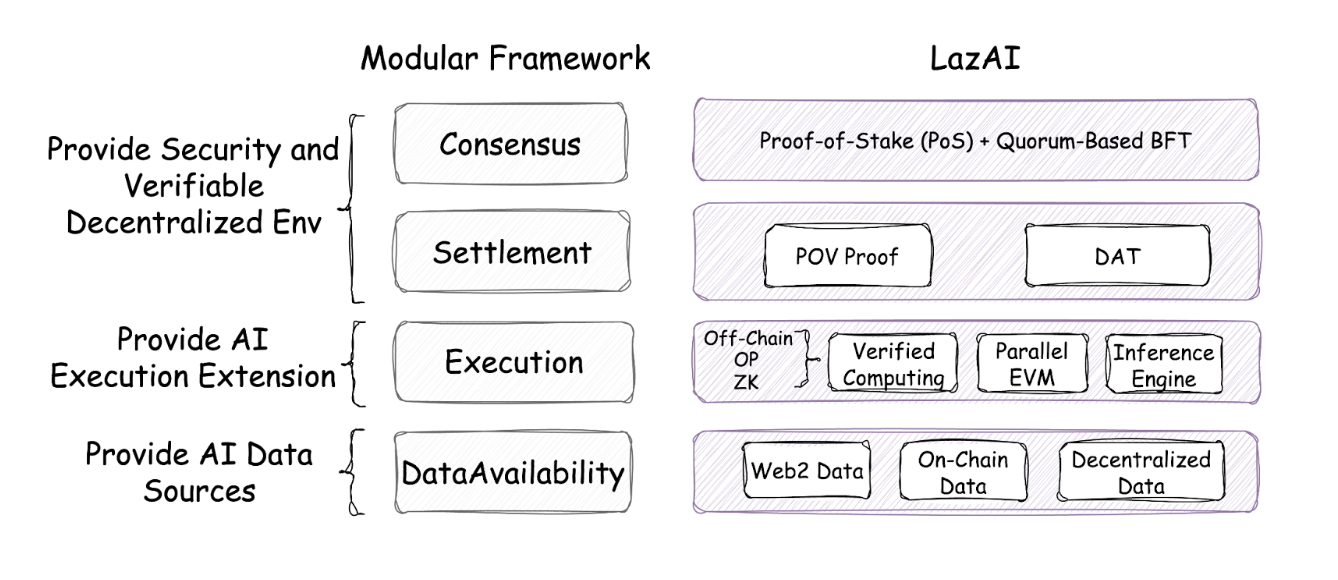
The Trusted Execution Layer forms the backbone of LazAI, ensuring secure, verifiable, and decentralized AI execution and governance. It leverages blockchain-based validation, high-performance execution, and scalable data availability mechanisms to optimize resource utilization while maintaining data integrity and computational trust.
### PoS + Quorum-Based BFT Consensus Protocol
To ensure data trustworthiness and execution reliability, LazAI employs a Quorum-Based Byzantine Fault Tolerant (BFT) consensus mechanism. Each Quorum functions as a decentralized iDAO responsible for governing, verifying, and securing AI-related data and computational processes.
**LazAI Consensus Layer has the following three features:**
1. **Decentralized Data Verification:** Each iDAO operates independently to validate datasets, training models, and AI agent execution before anchoring them on-chain.
2. **Optimized Off-Chain Storage:** AI datasets remain off-chain, while their cryptographic proofs and metadata are stored on LazChain, minimizing storage costs.
3. **High-Performance Data Processing:** The Quorum consensus model enables parallel verification and validation, reducing latency for AI model updates and execution.
**Its main advantages are as follows:**
* **Reduces Centralized Risk:** No single entity controls data governance, ensuring resistance to manipulation and censorship.
* **Transparent & Immutable:** All verification events and decisions are stored on LazChain, providing full auditability.
* **Scalable Data Governance:** iDAOs dynamically adapt to evolving AI datasets, allowing continuous validation and dispute resolution.
By integrating a Quorum-based BFT consensus, LazAI ensures high availability, low latency, and verifiable AI execution, forming a robust foundation for decentralized AI governance.
\
---
# Agent Instructions
This documentation is published with GitBook. GitBook is the documentation platform designed so that both humans and AI agents can read, navigate, and reason over technical content effectively. Learn more at gitbook.com.
## Querying This Documentation
If you need additional information that is not directly available in this page, you can query the documentation dynamically by asking a question.
Perform an HTTP GET request on the current page URL with the `ask` query parameter, and the optional `goal` query parameter:
```
GET https://docs.lazai.network/lazchain-components/consensus-protocol.md?ask=&goal=
```
`ask` is the immediate question: it should be specific, self-contained, and written in natural language.
`goal` is optional and describes the broader end goal you are ultimately trying to accomplish on behalf of the user. GitBook uses it to tailor the answer towards what is most useful for that goal.
The response will contain a direct answer to the question and relevant excerpts and sources from the documentation.
Use this mechanism when the answer is not explicitly present in the current page, you need clarification or additional context, or you want to retrieve related documentation sections.